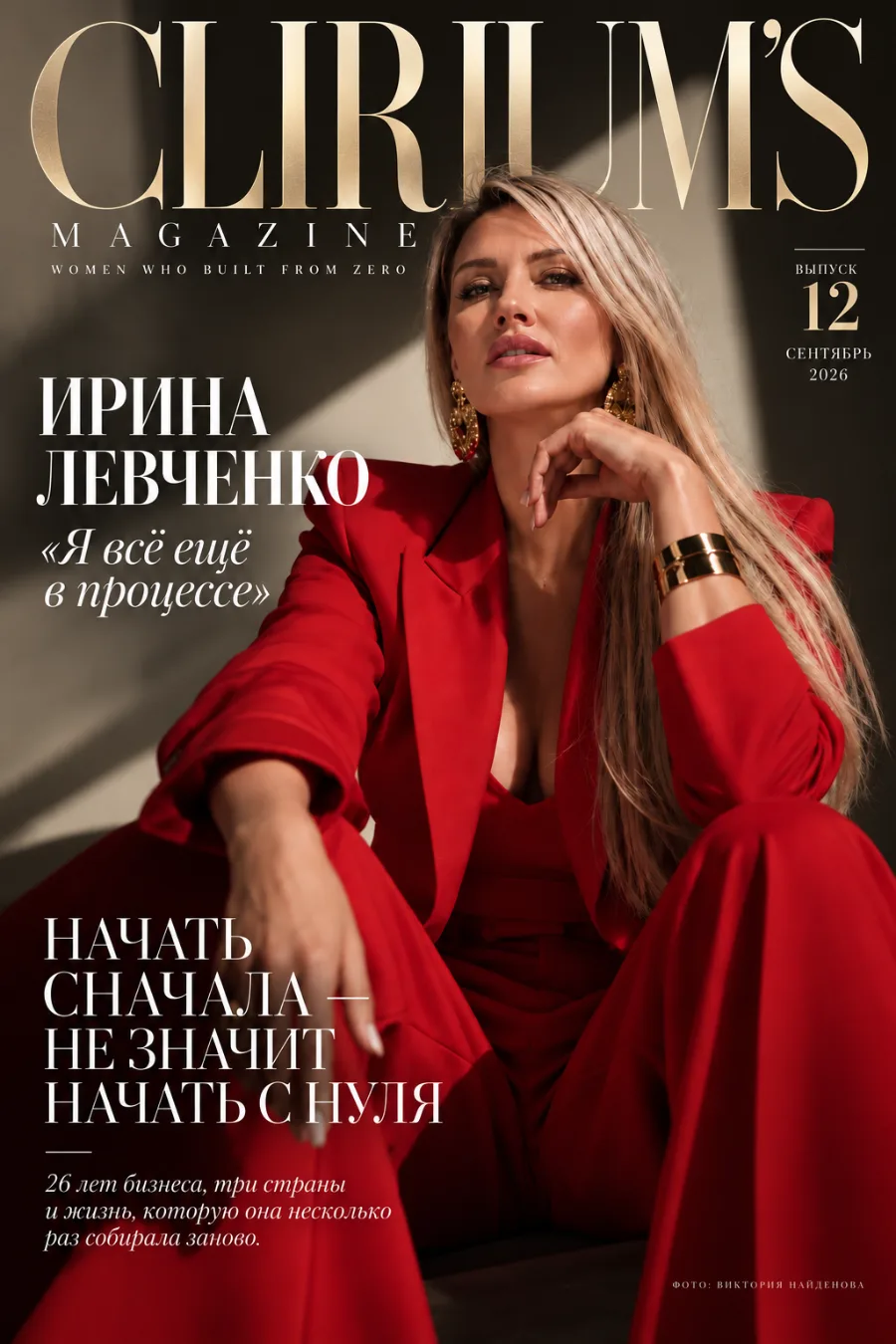
Clirium’s Magazine · Issue 12 · 09.2026 · Interview
Irina Levchenko: “I’m Still a Work in Progress”
Irina Levchenko on twenty-six years in business, three children, money lost and money earned, starting over again and again—and the freedom of not having to be a finished version of yourself
Featured: Irina Levchenko — Entrepreneur · Founder of the INSAID school · Astana and Dubai. Published: . Reading time: 28 min. Story and interview by Victory Naydenova.
Topics: Interview, Business & Entrepreneurship, Kids & Family, Freedom to Be Yourself
I met Irina—Ira, to her friends—at the Syucai school, where we were on the team that put together the “Business Intelligence” program. Then came the countries and the flights: first Ira came to my retreats as a participant, later we started leading them together, and out of that shared work, those shared mornings and shared roads, grew the particular kind of closeness that only happens when you work side by side and live side by side at the same time. I know her far too well to believe that a few lines of professional bio could explain who she is. We’ve seen each other not only composed and confident, but in the kinds of moments that never make it onto social media or into a résumé.
When you’ve known someone for years, you know them in fragments: you remember one conversation, one year, how hard things were back then and how a certain decision got made. Then life pulls you back into your own affairs, and only when you lay those scattered fragments out in a single line do you see the true scale of it. I did exactly that while preparing this issue, and the scale of Ira’s life turned out to be the kind that practically begs you to write a dramatic piece about a woman who went through the unimaginable and won anyway.
She tells her own story differently. Asked when she first felt she had made it through, Ira answers: “I’m still a work in progress, and I think it will go on my whole life.” To me that line is truer than any title. I don’t know her as a woman who once reached the right destination and has been enjoying the results ever since. I know her as someone who has, more than once, changed her very idea of what counts as winning.
I could line up everything she’s been through, add twenty-six years in business, three children, the medals, and the school—and wrap it all up with a few words about women’s strength. But “strong” is too small a word for someone who has lived such a varied life. We call people strong when they’ve endured. Ira didn’t just endure; she has repeatedly rebuilt the entire frame of reference by which she measures what’s good and what’s enough. That is a different kind of work, and there’s no short name for it.
In this issue we’ve stepped away from our usual format: Ira speaks in the first person, and I allow myself a few editor’s notes—not to explain her story, but to mark the places where I, as her editor and as her friend, deliberately stop. There are things you can’t retell on someone else’s behalf, and there are conclusions only that person has the right to draw.
What interests me isn’t how much Ira has endured, but what happened to her relationship with life—and from here on, she tells you that herself. “This is my experience, my life, the most incredible one that could have happened to me, and I love it,” Ira says. That’s the place I want you to hear her from.
Founder of CLIRIUM® ME
Her Story · In Her Own Words
Irina Levchenko
If you ask me today who I am, I can list plenty of things I’m genuinely proud of: twenty-six years in business, a company that operates in Kazakhstan, an international school, a book. But what I’m proudest of is something else: I raised three children myself, and despite everything that happened in my life I kept moving forward. I didn’t stop, I didn’t lose my mind—I keep growing and sharing what I’ve learned with the world.
People often ask me to name the moment when it became clear that that’s it, I’ve made it, and from here on everything will go right. I don’t have a moment like that. I’m still a work in progress, and I think it will go on my whole life. There’s always something to cope with; only the level of difficulty changes, we ourselves change, and situations have come, are coming, and will keep coming. I used to want a final answer—a place, a state, or a person after which everything would finally make sense and feel safe. Now I’m far more interested in life itself, where the answers are allowed to change, too.
I’m not telling this story to earn admiration or pity—I don’t need either. I’m telling it because over twenty-six years, women have come to me again and again with the same question: how did I survive all of it? And every time I understood that behind it was another, unspoken question: Does that mean I can, too? So here’s my answer—yes, you can. Not because I’m somehow special. The road I’m describing was never smooth or pretty, and maybe that’s exactly why it can be walked again.
I’ve been through genuine hell between the highs and the lows, between life and death—literally, not metaphorically. But if I had to describe my life in one word, I wouldn’t choose “survival.” I’d choose “curiosity.” I still want to know what happens next.
A childhood in which I learned far too early how fragile my body was
I was born in the Soviet Union—on October 14, 1976, in Khorgos, on the border with China—into an ordinary military family. My father served at a border outpost, and I spent the first five years of my life among soldiers and service dogs. By the way, I was born feet first, not the usual way, and my mom still jokes that I’d already decided to stand out. The outpost was my first world—kennels, a parade ground, and grown men in uniform who treated me like a little soldier. One day, playing with a kitten, I ended up inside an enclosure where one of the dogs mauled me badly. The soldiers didn’t hesitate: they cleaned the wound and patched it up. So you could say that my life in combat began at five.
That same year my parents divorced. After leaving the outpost, my father went to work in construction and started drinking. The divorce dragged on, with fights over property and scenes, and in the end it was just my mom and me. From age six to fifteen, my mom sent me every summer to Young Pioneer camps—the Soviet version of summer camp—for three or four sessions in a row, June through August. Today I’m actually glad she did: there was KVN (a hugely popular team comedy competition), contests, a stage, and a team, and that’s where I first felt I could lead people. As I like to say now, you don’t earn that kind of A+ sitting at home.
During my school years, my best friends were a dog—given to me so I wouldn’t die of boredom—and a piano. I didn’t like school itself. I skipped classes starting in first grade and was a real troublemaker, the kind who could lead the whole class off to splash around in a fountain or snack our way through an exhibition instead of going to lessons. In eight years I changed schools five times, and my mom, worn out by my antics, enrolled me in a culinary vocational school on simple logic: she’s not especially bright, not especially pretty either, but at least she’ll never go hungry.
I left that school on my own when I realized I didn’t want to spend my whole life smelling of pastries. I transferred to night school and, to my own surprise, started doing better—I graduated with only a single B—while working at the same time. At sixteen I was already a hair stylist; at eighteen I took second place at the Almaty championship in classic and bridal hairstyling. From the outside it all looked like the story of a feisty girl who got on her feet early and made herself. Inside, things were very different.
I’m sixteen, in Turkey, and to this day I have only one word for what happened to me there: slavery. I won’t say anything more about it. The details wouldn’t make this story any truer, and they wouldn’t make it any easier for me.
I’m eighteen. A car accident with three girlfriends, a spinal fracture, and a month and a half lying motionless, staring at the ceiling, just as I had lain in a hospital bed almost every year before that. I learned to walk again thanks to my mom and grandmother, who took turns sitting by my bed and believed in the strength of the spirit more than in any prognosis. After the hospital I got a job as a waitress at a club that was just opening and urgently needed someone who could type. I couldn’t, but I learned in a month, mastered computers and spreadsheets in two, and so the waitress became a secretary—and a year later, at nineteen, the club’s managing director, who was also put in charge of its currency exchange desk. Still, I got bored with everything quickly. I left to become secretary to the editor-in-chief of the newspaper Karavan, where I sculpted figures out of newspapers right at my desk until they ran a little item about me concluding that this girl belonged in the arts. I went back to hairdressing, at a modeling agency where I did thirty hairstyles a day at haute couture shows, and by nineteen I was working three jobs at once. Life was buzzing—connections, parties, my own apartment, my own car, an independent, cool young woman—and a whole lot of tinsel.
And then I’m nineteen, and there’s a moment when I didn’t want to go on living. Only a year earlier I had, you might say, been born again after the accident, and still, what happened, happened. I had absolutely no fear of death, but I was eaten up by insecurity. I thought there was something defective about me, and that feeling was fed by the vitiligo I’d lived with since childhood—patches of lighter skin—so whenever something went wrong I had one explanation: I’m not like everyone else, nobody wants to be friends with me because of the spots. My psyche was fractured. This is part of my life story too, and it’s still the hardest thing for me to talk about.
After that came doctors, long months in the hospital, a heart that faltered, a hyperbaric chamber—and out of all of it I took one simple thought that hasn’t changed since: whatever happens, you have to live.
Until I was nineteen, I ended up in the hospital almost every year—fractures, the accident, a poisoning. When people today hear the words “an active childhood,” they picture sports and trips. Mine was something else: I learned far too early how fragile my body was and how few guarantees life offers. You can state these facts in a few sentences, but inside a human life they don’t exist as a list. Between them were ordinary days, hopes, crushes, plans, and a very simple wish to live a normal life: I did my homework, went to dances, and dreamed of a home of my own, exactly like every other girl my age.
And one more thing. I don’t want the rest of my life to be explained only by what happened to me when I was young. I don’t consider myself the sum of my traumas, and I don’t build my identity on them—but I can’t deny their influence either. When your safety is called into question several times before you’ve truly entered adult life, you spend a very long time afterward learning what you can actually lean on.
A Note from Victory Naydenova
When you write about hard events in the life of someone close to you, there’s an almost automatic urge to use them to explain everything that came after—to link early trauma to her choice of partners, to a drive for control, to her business, or to the constant search for a fresh start. I deliberately choose not to do that. A human life is far more complex than any diagram, and another person’s pain doesn’t give an editor the right to become an all-knowing interpreter.
What matters more to me is something else: after events any one of which could have been the central plot of a separate story, Irina didn’t go on living in a genre of endless overcoming. She fell in love, built a family, built a business, had children, made mistakes, believed again, took risks, earned and lost. Her life didn’t become an appendix to trauma. It stayed a life.
Five years of happiness—and then the family was never the same
It was my future husband who pulled me out of the hospital. We moved in together, and a month later—I remember it like it was yesterday—he sat me down across from him in his office and said very seriously: “I’ve never loved a woman for longer than three days, and we’ve been together a month. Starting tomorrow you don’t work anymore. You’re my woman, and I love you.” I was wildly curious to see what would come of it—he wasn’t like anyone in the Almaty party crowd I was part of—and that’s how my married life began. I married at twenty-one—the first three years we lived together without a marriage license, then made it official—and for the first five years I was, as I say now, immeasurably happy. Not “we did okay,” but truly happy. It seemed like the best thing that could possibly have happened to me, and I thought that now, finally, I was safe.
My husband was an entrepreneur, and it was beside him that I learned the basics of business—how to run the numbers, how to negotiate, how not to be afraid of scale—and to this day, when something unusual comes up at work, I still ask his advice: he’s a wise man, and his advice works. He was terribly jealous, and to keep me from working in salons he came up with what seemed to him the best solution: he suggested I go back to school. So as a young mom I enrolled in university, and in 2002 I earned a degree as an educational psychologist. I had no plans to work in the field back then—and who could have told me that twenty years later this very degree would become the foundation of everything I do?
After our first son was born, we moved to the Emirates, where my husband also had a business, and lived there for about three years, training employees at a local factory to apply finishes to furniture. That’s where I discovered a completely new material—decorative plaster—and immediately went off to learn the techniques for applying it. My husband and I were crazy: we brought twenty tons of material to Kazakhstan all at once, rented three hundred square meters (about 3,200 square feet) in Almaty for an office, warehouse, and workshop, and completely failed to account for the fact that the market wasn’t ready. What was fashionable in Dubai simply didn’t sell at home. We spent three years teaching the market to work with this material before we started making money on it. That was my first big school of patience—when you put everything in and nothing comes back, and the only thing you have is the conviction that you’re right before your time.
Then came infidelity, and after it, alcohol entered our family story. My husband went bankrupt, he was drawn into politics, and what had so recently seemed like a solid structure started falling apart before my eyes. For a long time I couldn’t believe this was happening to me—everything had been fine, and I had finally done everything right. By the time we divorced I was earning three times as much as he was, and I couldn’t keep watching that money go to drinking. In 2007 we divorced, after ten years together in all.
From a distance of many years, it’s easy to revisit your decisions and think you should have seen it sooner, understood sooner, left sooner. But a person doesn’t make decisions with the mind she’ll have ten years later. She acts from whatever amount of experience, hope, fear, and love she has at that particular moment, and it took me a long time to learn not to judge my former self by what I know today. That twenty-one-year-old girl did the best she could with what she had, and I’m grateful to her for it.
After the divorce I didn’t want to adjust a few circumstances—I wanted to build a completely different life, and my first way of starting over was to move.
The UAE, a business, and a crisis that wiped out everything
I left for the UAE, opened a company, and for a while I literally lived between two countries. By 2007 the business was at its peak: together with my partner we completed more than a hundred and twenty projects—showrooms, apartments, interiors—and from the outside it looked exactly the way you’d want it to look: a woman coming out of a hard marriage turns her life in her own direction, and that life has work, momentum, a different environment, and new opportunities. I thought so too. It seemed to me that I had finally built something that belonged only to me.
In 2008 it all fell apart within a few months. First, circumstances were such that I broke off with my partner and left, walking away from everything. But our business was shared, both in the Emirates and in Kazakhstan, which meant long, grueling court battles ahead. My partner won my materials from me in court, I had to sell her the office, and the proceeds went to loans and debts. On top of that the global financial crisis hit, and suddenly nobody needed decorative plaster. By my estimate, the loss came to about $400,000—a sum that was completely insurmountable at the time—and I still remember the feeling when the numbers on paper no longer have anything to do with what you know how to do or how hard you work.
I returned to Kazakhstan with no money, pregnant with my second son, unmarried. The money I had was enough for a one-room apartment in a former military dormitory and some beat-up car. A dog came back with me from the Emirates—one that had cost $4,000, ate $200 worth of food a month, and later got sick. The friends and acquaintances who had once needed me disappeared, and only one person stayed by my side—my friend Yulia. That same year my mom’s husband, my stepfather, died, and she moved in with me, so there were four of us in that one-room apartment: my mom, me, my son, and the dog. Practically the whole year passed in a state I didn’t know how to name back then. I truly didn’t know what to do, and if it hadn’t been for the birth of my second son, I don’t know how it all would have ended.
That’s exactly the detail usually left out of stories about successful entrepreneurs: not “I pulled myself together and rebuilt,” but “I came back with nothing, pregnant, and somehow had to live starting tomorrow.”
I started climbing out of that year with two things. The first was a book: I came across Vadim Zeland’s Reality Transurfing, which became my bedside book—first I read it every single day, and then I started doing what it said. The second was my mom, who decided to help me with the kids. I talked Yulia into opening a company and applying plaster together, just the two of us. It was very hard, but two months after we started working I got a big offer, and with 20,000 tenge in my pocket (roughly $130 at the time) I moved to Astana, the capital, where I lived with friends for six months because I had nothing to rent with. A year later I had an office bought on credit and a three-bedroom apartment with a mortgage, and I moved my mom and sons in. I hired a new team, we got to work—and we’re still working today, in both Astana and Almaty.
For the next ten years I rebuilt myself, the company, my nerves, and my ability to look ahead. When people see an entrepreneur many years later, they see a stable business and think of talent, courage, and character. Far less often do they see the years when you’re simply winning back what you had already built once, with no certainty at all that you’ll ever get back to where you were. This isn’t a story of a meteoric rise. It’s a story of a very long, very boring, and very honest comeback.
A Note from Victory Naydenova
Entrepreneur biographies have a well-worn genre—“lost everything and two years later made ten times as much.” It reads beautifully and almost always turns out to be untrue—not because such stories never happen, but because the most important part has been cut out: the tedium of recovery. For Ira it took ten years, during which nothing happened that you could write a post about, other than the business running a little more steadily each year than the year before.
I think this, and not the dramatic twists, is the skill she later began passing on to other women: the ability to stay in the process when the result isn’t visible, to work without any promise that the effort will pay off—a skill no business school teaches.
Business never became a pretty success story for me
My company has been operating in Kazakhstan for twenty-six years now, supplying and applying decorative wall finishes. It’s not the kind of field people write inspirational posts about. It’s construction: deadlines, contractors, materials, crews, and job sites that have to be handed over on time. There’s no room here for grandstanding or pretty talk about mission: there’s a wall, there’s the material, there’s the craftsman, and there’s a result that either came out right or didn’t. Maybe that’s why I love this work so much—it doesn’t let you fool yourself.
It’s this work that gave me financial footing, a reputation, and—most important to me—the chance to pursue, alongside it, what I was truly drawn to: psychology. Until I had solid ground under my feet, I didn’t let myself seriously pursue what really interested me. That took twenty years, and now I do it without justifying myself to anyone.
It’s from this same unglamorous world that the things that sound like titles today grew: I’m a national expert for the WorldSkills Kazakhstan championship in the Decorative Plastering skill and a coach for the national team that prepares students for professional competitions. I have a medal from the Ministry of Education for my contribution to technical education, a “Builder of the Year” award, and a place among the “100 New Faces of Kazakhstan.” I’m not listing these to impress anyone. To me they’re proof that the craft I once started with—first with scissors, then with a trowel—can be passed on, and that the girl from culinary school who was told she’d smell of pastries all her life now stands on the other side, teaching others to make beautiful things with their hands.
I can still go out to a job site and apply a finish myself, and painting murals on walls is still one of my hobbies. That’s not me being coy: when my head is in a bad place, I grab a trowel and go to the wall.
The marriage I barely got out of alive
When the company was back on its feet and the kids had grown a bit, I married for the third time—a man younger than me—and once again believed that this time everything would be different: after all, I was older, more experienced, I had my own business and a good head on my shoulders. It turned out that neither age, nor experience, nor money protects you from meeting a tyrant. I’ll keep the details of that period to myself and say only that my daughter was born in that marriage, and that I got out of it, as I put it, miraculously alive.
That’s when I finally understood what life had tried to teach me many times and what I had stubbornly refused to hear: no one is coming to save you—not a husband, not a partner, not a teacher, not circumstances—and the only one who can help me is me. It’s a loss and a gain at the same time: I lost the hope of a rescuer and found a foundation that can no longer be taken from me.
That’s where my path of transformation began—not as a pretty word from a social media feed, but as the only possible way to keep living—and I became a mentor and guide for women like me, women who one day realized they could count only on themselves and don’t know what to do with that knowledge next.
At every one of my breaking points the same thing happened—a reassessment of how I saw the world. I changed myself, my life, cities, homes, and partners. But the most important thing was that each time I lost my joy and my faith in life itself, and each time I had to find them again, somewhere else and with different hands.
A Note from Victory Naydenova
We discussed for a long time whether to keep this passage, and Irina decided to keep it, but without details. As her editor, I support that decision: our job is not to document someone else’s pain, but to protect the heroine’s right to decide for herself where the line between public and private lies. What matters here isn’t the plot but the conclusion she reached—and that belongs to her alone.
I’ll note just one thing: when Ira says “no one will save you,” it doesn’t sound like resentment or a declaration of independence. It sounds like liberation. There’s a big difference between someone who has stopped expecting help because she’s given up on people and someone who has stopped expecting it because she has finally seen her own strength. Ira is the second kind.
Bali: the riskiest decision
If you ask me about the riskiest decision of my life or my career, I won’t name the first twenty tons of material, or the company in the Emirates, or Astana with 20,000 tenge in my pocket. All of those decisions were risky, but they made sense—I knew what I was doing and was prepared to pay the price. I’ll name Bali.
I went there looking for a new life, with a feeling that I think many women know after hard years: that somewhere, surely, it’s better than at home, and that if you change everything at once—country, climate, circle, rhythm—a new life will start on its own. From the outside it looked beautiful once again—the ocean, freedom, a reset, the spiritual island. Inside it was different. In the end I lost myself, my money, and the desire to live the way I used to, with no idea where to go next: the old life no longer fit, the new one wasn’t arriving, and I was stuck in between.
It was a farewell to an illusion—the one that had followed me since my youth and told me that a move, a new city, a new country, or a new person beside me could wipe the slate clean. Because geography can’t heal what’s happening inside. You bring yourself along, with all your fears, your exhaustion, and your habit of waiting. A new life doesn’t begin in a new place; it begins where you finally stop running.
I came home, and I think for the first time in my life I came back not because something hadn’t worked out, but because I understood that home isn’t a point on the map—it’s a state in which you can stay yourself. Since then I travel a lot—Dubai, Bishkek, temples, places of power—but I no longer expect any place to save me. I travel not for rescue but for experiences, and that’s a completely different road.
The science that told me: you’re a coach
In 2019 an economic crisis hit, and right behind it came my own. I was starting to burn out: for almost twenty years I hadn’t gone anywhere for longer than three days, I combined every vacation with work, and I didn’t know how to stop—because in my life, every stop had always been followed by a fall. In 2020 came a huge reassessment of my values: I was disillusioned with my country, with how women were treated, with myself—and I was once again getting ready to move to the Emirates, where I had already bought commercial space and planned to work.
And then people started appearing in my path who led me in a direction I had no idea about at the time. On my birthday in Dubai I met Victoria, who became my English teacher, and through a chain of her connections I ended up on a yacht at an event for crypto investors, where, before the company founder’s talk, Sergey Teplykh took the floor and told everyone about the Syucai method and the “number of consciousness.” At first I decided it was feng shui, numerology, all things I’d seen before—but everyone around me started calculating: What’s my number? What about mine?
Then we went out to a ranch, and there we got to talking. Sergey broke down my date of birth, told me about the energies I’d come into this world with and what my purpose was, and then said, “You’re a coach.” Me—a coach? I’m a businesswoman, actually. He insisted, and back then it all seemed strange to me, but something in my soul caught on. A seed had been planted in my mind, and it grew—slowly but surely.
After that trip I came down with COVID and was completely cut off from work: I lay there with a fever of nearly 104°F (40°C), unable even to look at a screen, and the only thing I could do was listen. Sergey gave me access to his intensive course, and it became my lifeline while I was sick: I listened, and my brain savored the new knowledge. I think that’s when the idea came to go further—to study what I loved, to understand myself and everything around me. A few weeks later I was on my way to Bishkek, Kyrgyzstan, for the eleventh cohort of the Syucai school, with a purely practical goal: to figure out how to use this method in business, strengthen my team, put everything in order, and, naturally, make more money. And that’s where the catch was—something went off script, and a new stage of my growth began, in every area of my life at once.
I don’t want to describe this as a miracle; I don’t like the language of miracles at all, because it takes responsibility away from a person. It’s more accurate to say this: I learned to align the day, the energy, and the intention. I now forecast all my contracts, trips, and meetings, and the science of numbers has become a working tool for me, just as Excel spreadsheets once were. My state of mind changed, I began to see events and people differently, and happiness became a frequent guest. And in that state I wanted others to become a little happier too. That’s how the Happy People club came about, along with my signature marathon “2022: The Year with FORTUNA,” the “Business Intelligence” program that we created as a team with Victory Naydenova, and the Prosperity retreats, which I first attended as a participant and later co-created.
Perfume is a story of its own. In consultations people kept asking me what to do if their numerological chart had no threes, or was missing some other number, and I began thinking about how to build up the missing energy in a person not with words, but through the body, through scent, through sensation. That’s how Fortuna ILY numerology fragrances came about—nine compositions created to my order by a perfumer in Dubai, each reflecting the energy of its number. What I like about this story is one thing: I didn’t invent a product; I heard a question and didn’t brush it off.
Now I’ve opened my own international school, where I teach a free-form philosophy of numbers based on psychology, numerology, and other disciplines. My main ability, as I now understand it, is creating the conditions in which a person can see for themselves the real, not subjective, situation they’re in: I don’t see it for them—they see it themselves. And that’s the whole difference between a guide and a rescuer.
So the prediction on the yacht came true, and I really am a coach—it’s just that the road there ran through a quarter century in construction, three marriages, two bankruptcies, and one attempt to run away from myself to the other side of the world. Sometimes I wonder: What if Sergey had told me this at twenty? I probably just wouldn’t have heard it.
What people see—and what they don’t
I try not to hide anything and to show everything as it is, without pretense or fake set dressing—just as I am. How people see me is up to them, not me. I suppose people see the business, the medals, the school, beautiful shots from Dubai, and a woman who travels a lot and looks good. But they don’t see ten years of rebuilding from zero. They don’t see that behind every “I moved” was “I couldn’t afford to rent an apartment.” They don’t see a one-room apartment shared by four with a sick dog. And they don’t see that the most important things in my life can’t be posted at all.
People often introduce me as a woman who controls everything, and that’s not true. I’m a woman who spent a very long time learning to control just one thing—my attitude toward what’s happening. Nothing else answers to me, and it never has. The market crashed when it wanted to, people left when they wanted to, my body broke down when it wanted to, and the only thing that remained mine was the choice of what to do next. And every time, I chose to live.
My children
If we’re talking about my greatest achievement—not in terms of status, but personally for me—it’s my relationship with my children: two sons and a daughter whom I raised myself, and the kind of people they’re growing into. That’s the one thing I’m proud of with no caveats and no “buts.”
A single mom of three with a construction business and not a single person to back her up—that isn’t a role anyone chooses. But it’s the one that taught me what no books or coaches ever did: to be there for my kids every day, even when I had no strength left at all. My children have seen me in every state—they saw me fall, and they saw me get back up. I didn’t hide life from them, and I think that’s exactly why we have a real relationship, not a decorative one.
My oldest son was born when I was a young wife full of illusions; my middle son when I came home with nothing and didn’t know how I’d live the next day; my daughter in a marriage I later had to escape. Each of them arrived at the hardest point of my life, and each time they were the reason I didn’t stop.
A Note from Victory Naydenova
We began this story with the line “I’m still a work in progress,” and Ira herself will come back to it, because it holds all of who she is. She doesn’t offer readers a finished result to strive for. She offers something more honest and more difficult: to stay in the process when no result is in sight, and to love that process before it rewards you. To me, that’s the most grown-up definition of happiness I’ve ever heard. What follows is her final word, and I won’t comment on it.
One decision
People ask me which single decision changed the trajectory of my life the most, and I can’t name just one—there were many: leaving culinary school, going into the hospital and coming out of it, getting married and getting divorced, moving to the Emirates and coming back, moving to Astana with 20,000 tenge, stepping onto that yacht, going to Bishkek, leaving for Bali and coming back from Bali.
But behind all of them is the same rule, one I worked out for myself and repeat to every woman who comes to me: it’s never too late to change everything as long as your heart is beating, because everything is in our hands. If you can’t go on like this anymore—don’t. Start over, differently. Everything is possible. That’s not a slogan. It’s the one thing I’ve tested on myself so many times that I no longer doubt it.
I’m still in the process of getting to know myself. I’m fascinated by life itself. I have no idea what’s still to come, but somehow, to me, that’s a good thing. This is my experience, my life, the most incredible one that could have happened to me, and I love it.
Irina Levchenko is an entrepreneur and the founder of Mas Design Studio LLP (Astana, Almaty), a company that supplies and applies decorative finishes and has operated in Kazakhstan for more than twenty-six years.
National expert for the WorldSkills Kazakhstan championship in the Decorative Plastering skill; international coach for Kazakhstan’s national team, preparing students for professional competitions.
Medal from the Ministry of Education of the Republic of Kazakhstan for her contribution to vocational and technical education; “100 New Faces of Kazakhstan” medal; “Builder of the Year 2022” medal.
Certified educational psychologist; business coach; trainer at the Academy of the Syucai International School; co-developer of the “Business Intelligence” program.
“Psychologist of the Year” at the Prosperity 2020 awards.
Creator of the marathon “2022: The Year with FORTUNA”; founder of the Fortuna ILY numerology fragrance brand; co-creator of the Prosperity retreats; founder of an international school of numerology-based psychology.
Mother of three.


Discussion
{{ cCount }}Be the first to share your thoughts on this story.
{{ c.text }}